

The Information Services Department, National Gallery of Art Lagos Outstation recently conducted an insightful interview with renowned artist, Raji David Odeteju. The discussion explored his inspirations, aspirations, expertise, accomplishments, and visions, offering a captivating glimpse into his creative journey.
Get ready to be inspired!!
Can we meet you? Tell us about your educational background and training.
My name is Raji David Adeteju. I’m 43 years old. I grew up to be an artist and further, to study art in school. I got my OND and HND, specialized in painting. I studied painting and general art in my HND level. And ever since then I’ve been practicing, close to 27 to 30 years now, I’ve been practicing art. Even before entering into National Gallery of Art as a staff, I’ve been an artist, a practicing artist.
What sparked your interest in art?
As a child, I grew up and discovered art in myself. Art is an inbuilt thing, and it’s something that is in you. At that time, my dad wanted me to go and learn carpentry work and that’s what took me to Kaduna, because my primary school, secondary school was in Lagos. My dad, had a friend, his son was learning carpentry work in Kaduna. So he wanted me to also go there to learn carpentry work.
My mum wanted me to follow the art trade that was already in me but as God would have it, the month he wanted me to go was when they started the Kaduna riot, so I couldn’t go. So after that, I went to meet one of my uncles in Abuja who was doing art. So I started learning art with him. I have it in me, but you know, no matter what you know as a child, that’s a child’s art, you need to furthermore. So learning with him, I got to know more about art. You know, art is beyond what you think that you know. So I got to know more about art, and that’s what led me to Auchi Polytechnic to study more.

What is art to you?
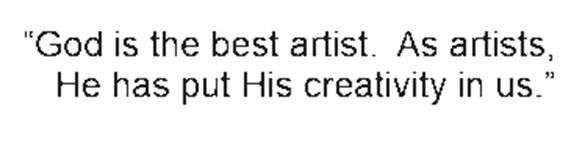
Art to me? Art generally is a way of life. God is the best artist. And we as artists, God has put this thing in us, creativity. An artist is like a signature.
You may be using the same material with someone but each artist has a signature. When you see it, you know that this style is this artist, or this work belongs to this artist.
So art, to me is an inbuilt thing that… generally is creativity. It’s what you have inside that you can’t just let go. Sometimes when I see an artist not practicing, it pains me because he’s just wasting the talent. I was telling my wife that a white man just saw my work on the internet, and he said, can I buy some of your work? I said, yes. He said, how much? Jokingly, I just said $2,000.
He just said, okay, is it an original piece? I said, yes. He said, okay, I will pay. Just like that.
How would you describe your artistic style?
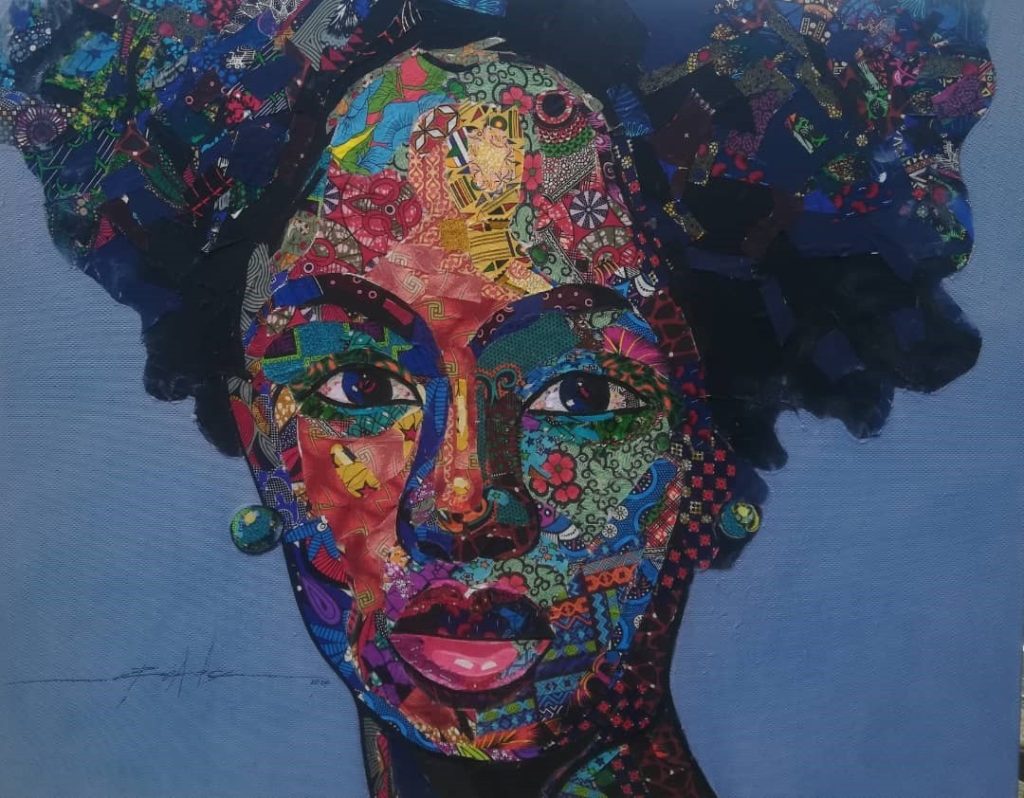
My artistic style is collage. Collage expression. I call it expressionism. I’m not painting realism. Realism is when you say, I want to paint sister Chinwe the way she is. Colour for colour. The sky is blue, I want to paint it blue. When you’re talking about expressionism, I can use anything to represent my object. I want to paint madam Chinwe, I can use blue colour to represent her. That’s expressionism. I’m just trying to express myself with fabrics. The style itself is collage. Collage is when you cut pieces of material and put them together. I call it collage expressionism.
What inspires your artistic style, the use of fabric on canvas?
In school, they don’t teach us this. I didn’t learn this in school. During my final year project in school, I made use of these Dunlop slippers to do my project. They carried the work and put it in the office of the rector. After school, I still practiced it. I’m looking for a flexible material. If I want to send work abroad, I can easily send it. But this Dunlop material doesn’t give me that freedom. I cannot roll the work. Even from my base in Benin, sending work to Lagos is difficult. I’m just looking for a material that I can manipulate. If you ask me, can you send this work to anywhere at all? I can easily roll it. I stumbled into fabrics. Before fabrics, I used Dunlop slippers. I used all kinds of plastic to experiment. They all come out well, they are nice. But the challenge I have with it is that I can’t travel with it. I can’t do large work. I can’t do up to this size when I was doing this material. But with this, I can even do a larger size that is bigger than this {referring to a particular work in his studio}
The project you talked about in school…tell us about it.
It was robber…I cut in pieces. Just like the fabrics I have here.
Tell us about your creative process.
My creative process… First of all, as an artist, a painter, you first of all stretch your canvas. After stretching the canvas, you now have a sketch. You make your sketch. But before that, you have something you want to do in mind. Maybe your reference that you want to use. You have a reference that you are going to use for the work. After stretching the canvas, I go ahead and make my sketch. After the sketch, I arrange my fabrics, and the colours to use. After arranging the colours, I start cutting. I’ll be observing my picture, the reference. I’ll be putting the colours together. At first, you may not like it because you may not understand what this guy is doing? But when you see the finished work, you like it.
Am I permitted to call this a fabric on canvas? Yes, this is a fabric on canvas. That’s the medium, fabric on canvas.
How do you select your fabrics for your artworks? And what techniques do you use to adhere it to the canvas? Do you experiment with different fabrics, the weights and the textures before using them?
I select them colour by colour. If I want to use blue, sometimes if you look at this now, I have a grade of green, blue, up to lemon green. And I cannot use the same fabric for the head tie. But for everything to harmonize, I have to bring a bit of this colour of the face to the head tie. So that it will not separate from each other. If you check this one at your back, you’ll see also a similarity. Because if the fabric on the head tie is different and you don’t have any bit of the colour surrounding, it makes it separate. You will not enjoy the work much either. Either thick or light, I still have some fabrics that are thick. It’s just the colour. Okay, this is chinos for instance. I still make use of it. It’s thicker than ankara, so I use them to achieve all these lifts and all that. So it doesn’t matter the thickness or the lightness. What I enjoy and that gives me joy in it is the colour.
I know you said something about colour. I want to ask you, how do you balance the texture and the colour in your artwork? Like you put green here, why not put it on this side? How do you know where to put a particular colour?
Yes, that’s where the artistic understanding of colour comes in. In school, there is something we call colour theory. You have to study your colours. We have warm colours, we have cool colours. If you check this side, {referring to a piece of work in his studio} you see that these colours here, they are all under cool colours. And here is warm colour, which I use this warm colour to bring out the cheek of the lady. When you are looking at the work from a distance, this area will attract you more than here. They are in one place, but this area is where the attention will be more. So these are warm colours. Warm colours, are orange, yellow and red. These fabrics, they are warm colours. While cool colours are blue, purple, green, brown. They are cool. You can’t separate them because they are interwoven. They go together.
Are there any symbolic meaning behind the fabrics and patterns?
No.
Do you use blending and layering techniques?
No, I don’t blend. There is nothing like blending. Look at it. You can see the layer. This yellow is on top of this .But when you are looking at it… Yeah, I use layering. Nothing like blending. I don’t blend because you can’t blend a fabric. You can only do blending maybe when painting. You use brush to blend blue together with red and all that. But you can’t achieve that here. But if you are looking at this, it looks as if the colours are blended together because of the relationship they have.
How do you achieve your texture with acrylics?
After the main work of the ankaras, I use acrylic for the background of the work. It’s not as if I can’t use ankara on the background also but I don’t want it to be complimentary, to be distracting. The colours will be too much. So, I need plain colours for the background to shoot out the object. So, in achieving texture in acrylic, I make use of a pattern.
Is this done before the work or after the work?
After the work.
Are there specific acrylic affects you aim for?
On the work? Yes. Like, this one {referring to a piece of work} has red and, I don’t know what colour it is, probably pink or something. So, all of them are not same? It’s not a particular colour, but, you know, the thing is that, if I look at my work, I pick a colour from the work itself, from the ankara, and initiate it into the background. So, there must be a relationship between the background and the colour. Sometimes I mix two colours from the background. Like this, this red is a base, inside this blue. They are giving me that purple. So, sometimes I mix two colours together, so that when you are looking at the work, it looks as if this work is, you can’t separate it. Maybe I make the work before the background, but it looks as if, it’s that you just gum it on the background, or you make the background before the artwork itself.
Apart from fabrics, and acrylics, is there any aspect you do? Like mixed media or incorporate other materials into your work?
Yes, I do mixed media, I make use of charcoal, that’s charcoal crayon. I make use of acrylic, I make use of fabrics. So, it’s mixed media, because any artwork that is beyond one medium is mixed media. So, sometimes I mix all the mediums together, just to achieve my aim.
What challenges arise when you are working with fabrics and acrylics?
Oh, the challenges is that sometimes you may not get the colours that you really want to use. You know, it’s not like a pigment, I need a pink acrylic, I go to the market and buy it. But, if I need a pink fabric, I want to go and buy it in six years. So, those are the challenges, but as an artist, you still find your way around it.Sometimes I go to market to buy, there are some colours that I know that I cannot get. So, I will go to market to buy them in two yards, one yard, just to finish the piece.
So, what challenges do you face? Have you ever experienced colour or texture inconsistencies, adhesion or stability issues? In the sense that, okay, you might want to stick it to something, it’s not sticking. You’ve already finished and you notice that some parts are coming and that kind of stuff.
No, I’ve never experienced that, because immediately I cut the shape. I use top bond to stick it to the canvas. And, sometimes, maybe I discover that the colour, I put grey here and I discover that, no, this grey doesn’t go well with this area. It doesn’t give me what I really enjoy. Because, as an artist, you have to satisfy yourself before the audience. You know, when you are happy and you know that, oh, this thing is good, then other people that will see it will know that, yes, it’s good. But, if you are not satisfied, you cannot satisfy the audience. So, sometimes, I work and I see, no, this thing doesn’t go well. It’s either I try to pull it off or I lay another fabric on it till I get my desire. Sometimes, it’s not easy because of the gum, it’s not easy to pull off. Except the one that I’ve not stick, that I’ve not dried, I can pull it off. But, I’ll just lay another fabric on it. It makes the work look heavier as well.
So, now, you are telling me that the fabrics can’t pull off once they stick up even in the next 10 years?
It can’t pull off. Except maybe they poor water on it. And nobody will carry an artwork and begin to soak it in the water.
How do you ensure that your works are durable?
Let me just say it’s like that.
Are there specific materials you use to achieve that?
No. We have experimented with acrylic and oil colour. They stay longer. But in terms of this fabric, I have work that I’ve done 8 years ago, and they are still intact. But I don’t know how long, because, I just started this style 8 years ago. So I don’t know how long it’s going to be. But I know acrylic lasts longer, oil colour lasts longer. But these fabrics, we are still experimenting.
What is the biggest challenge you have faced as an artist?
Well, the biggest challenge is marketing the artwork. Sometimes you have an artwork, you don’t have a market for them. It’s a challenge and it makes you not to be known. Sometimes you just look at yourself and ask yourself, why you are working? You look as if you are wasting your time and all that. But if you just carry on, there’s always hope. That’s just the challenge.
This insightful interview was carefully prepared and conducted by:
Nwude Chinwe
Oluwunmi Olamide
Dike Charles
Transcription and Editing:
Ikeh Nkemjika